



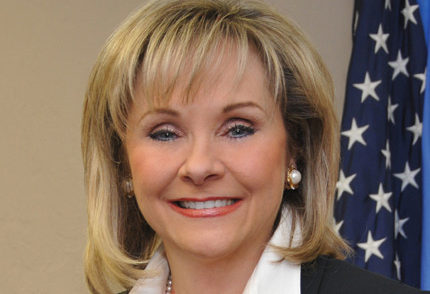
Governor gives State of the State, gets responses

Advertisement

Governor Mary Fallin delivered her State of the State address on Monday in which she outlined her priorities and her budget. We have included her office’s press release with a full outline and have given you responses we have received from Oklahoma House Democrats, Oklahoma Policy Institute and Americans for Prosperity. The responses follow the Governor’s press release.
From the Governor's office
Governor Mary Fallin Monday delivered the annual State of the State Address in front of a joint session of the Oklahoma Legislature. In it, Fallin focused on the urgent need to improve the state’s budgeting process to ensure that legislators can adequately fund priority goals related to education, public safety, health and more. A copy of her State of the State Address is attached to this email. The proposed Executive Budget for Fiscal Year 2016 (FY 2016) can be found here:http://www.ok.gov/OSF/documents/bud16.pdf
Fixing Oklahoma’s Unsustainable Budget Trends
Governor Fallin showed legislators two graphs during the State of the State: the first chart tracks total tax receipts, which continue to grow; the second shows the shrinking level of dollars that legislators are actually able to appropriate (see attached graphic). This year, legislators will only appropriate 47 percent of total Oklahoma tax receipts, down from 55 percent in 2007. That means legislators will have fewer total dollars to appropriate than in some years past, despite the state collecting more total dollars.
“Slowly but surely, elected representatives are losing the ability to guide state priorities and the flexibility they need to respond to changing circumstances. My challenge to all of us is to reverse that trend and use this session to really unpack the way the state is spending its money. …
“As a state, we spend a lot of money now on programs we hope are working. We need to identify and support programs we know are working.” – Governor Mary Fallin
To balance the budget, ensure the general revenue fund is not eroded further, and improve the overall budgeting process, Governor Fallin proposed:
o Adopting “performance informed budgeting” that links spending to measurable goals and outcomes (Governor Fallin today launched OKStateStat.Ok.Gov which includes over 160 of these measurements)
o Passing legislation requiring every tax credit and economic incentive to be evaluated through an objective process established by the Pew Charitable Trusts
o Redirecting $300 million of the $1.7 billion in agency revolving funds to the General Revenue Fund in FY 2016 while pursuing long-term policy changes regarding the need for large cash balances kept by some agencies (note: over $900 million in agency revolving funds is currently unencumbered, meaning it has not been obligated for a specific use)
o Considering non-budgetary policy issues every other year, to ensure that one of every two years is a budget-only session with increased scrutiny and participation
Addressing State Priorities and Areas that Impede Oklahoma’s Growth and Quality of Life
In her State of the State address, Governor Fallin said that growing the economy, improving quality of life, and making government more efficient and effective continue to be her overarching goals in office. To pursue those goals, Fallin said the state needs to overcome hurdles in three specific areas.
Educational Attainment
“We must encourage more Oklahomans to continue their education beyond high school. Currently, Oklahoma’s workforce is not meeting the education levels needed to sustain potential job growth. For Oklahoma businesses to meet labor demands and Oklahoma citizens to find good jobs and careers, we need to address the emerging ‘skills gap.’” – Governor Mary Fallin
To ensure more Oklahomans are receiving the skills and education they need to succeed in the workplace, Governor Fallin:
o Proposed $25 million of increased funding for the Department of Education
o Announced the launch of “Oklahoma Works,” a new program that develops partnerships between K-12 schools, career tech, higher education and local businesses to help promote work skills, increase degree/certificate completion, and help steer students towards available careers (more information available at OklahomaWorks.gov)
Incarceration
“Personal and community safety remain top priorities, and violent criminals will continue to be incarcerated. But the fact is, one in eleven Oklahomans serve time in prison at some point in their lives. Many of our current inmates are first time, non-violent offenders with drug abuse and alcohol problems. Many also have mental health issues they need treatment for. For some of these offenders, long sentences in state penitentiaries increase their likelihood of escalated criminal behavior.
“Oklahoma must ramp up its ‘smart on crime’ policies, including the Justice Reinvestment Initiative, designed to intervene for low-risk, non-violent offenders and more readily offer alternatives such as drug-courts, veterans courts and mental health courts.” – Governor Mary Fallin
To reduce the incarceration rate among non-violent offenders and ensure they are getting treatment and supervision, Gov. Fallin:
o Proposed greater levels of funding for agencies that help implement “smart on crime” policies, including a $5 million increase for the Department of Mental Health and Substance Abuse Services and a $15 million increase for the Department of Corrections
o Announced a steering committee of state leaders to ensure “smart on crime” policies are being implemented
o Advocated for greater use of mental health, drug and veterans courts that steer non-violent offenders away from the justice system and towards programs providing supervision and treatment
Health Outcomes
“Oklahoma ranks at the top of the nation for prescription drug abuse; fourth in the nation in unintentional drug poisoning deaths; seventh worst for obesity; sixth worst for smoking rates. …
“It’s time to stand up and fight for better health. Every Oklahoman can do better in taking personal responsibility for their own health. But there are things we can do here at the capitol, starting by passing a prescription drug monitoring bill that cracks down on the practice of “doctor shopping” and ensures we aren’t prescribing narcotics to addicts.
“We can pursue commonsense solutions: like going smoke-free at all K-12 schools, and banning practices like texting while driving that kill Oklahomans – many of them teenagers – every year.” – Governor Mary Fallin
To help improve health outcomes for Oklahoma, Gov. Fallin has advocated:
o A $20 million increase for the Oklahoma Health Care Authority
o Passage of a prescription drug monitoring bill to keep dangerous prescription narcotics out of the hands of addicts
o Passing legislation to ban texting while driving
o Going “smoke-free” at all K-12 public schools
o A statewide goal of decreasing heart disease deaths by 25% by 2025, which would save over 2,400 lives every year
To read the governor’s full text of the 2015 State of the State, click here.
Responses
House Democrats ‘Cautiously Optimistic’ About Governor’s Priorities for 2015
House Democrats are “cautiously optimistic” that Governor Fallin’s 2015 legislative agenda will focus on core functions of state government that are most in need of attention, Minority Leader Scott Inman said Monday.
During her first four-year term the governor “railed constantly against the federal government,” while House Democrats emphasized local priorities such as public education, health care and public safety, Inman said.
But with Oklahoma at “a critical point,” it appears that Fallin “has finally come around to our way of thinking,” the Del City Democrat said.
During her annual State of the State address Monday to the Legislature, the governor cited education, health care and public safety as her top three priorities. “We are in agreement with her on the priorities, but the devil is in the details,” Inman noted.
While Fallin maintains that she wants to improve education in Oklahoma, “She has presided over shrinking education budgets, increased mandates and larger class sizes,” Inman said.
In the area of public health, Fallin has adamantly refused to “bring our federal health care dollars home,” even though one of every five Oklahomans – 665,000 people, according to the state Health Care Authority – have no health insurance, Inman related. Consequently, he said, Oklahoma hospitals are providing approximately $600 million in uncompensated health care benefits to impoverished, uninsured citizens.
House Democrats join the business community and several Republican legislators in support of efforts to expand the existing Insure Oklahoma program, Inman said.
He said he applauds the governor’s renewed focus on the issue of criminal justice reform, but is critical of her appointment last month of a steering committee comprised exclusively of Republicans tasked with developing justice reform measures by the end of 2016.
“An effective package, developed by a bipartisan panel of which I was a member, was proposed by former House Speaker Kris Steele,” Inman recalled. “It was approved with overwhelming Democratic support and was signed by the governor herself in 2012. It was the Justice Reinvestment Initiative, and it would accomplish the goals that the governor laid out in her new proposal.”
Appointment of the Republican steering committee amounts to nothing more than “kicking the can down the road for two more years,” Inman charged.
When asked how he proposes to pump money into public education, expand health care and pay for justice reform measures, such as additional parole officers, Inman said he would eliminate “wasteful tax credits and tax incentives” and stop reducing the state income tax. The income-tax cut the Republican-dominated Legislature approved last year will carve $200 million in personal and corporate income taxes out of the state treasury.
Inman also said that other options, “not to exclude” tapping into the state’s $535 million ‘rainy day’ fund, “should be on the table.”
Governor Fallin’s budget leaves Oklahoma’s best tools on the shelf
Oklahoma Policy Institute Executive Director David Blatt released the following statement in response to Governor Fallin’s proposed state budget for 2016:
Governor Fallin rightly recognizes that Oklahoma needs to boost education funding, reduce incarceration, rein in tax breaks, and improve our citizens’ health, and her push to evaluate government programs using clear metrics may be very beneficial. Unfortunately her budget leaves on the shelf the best tools we have to accomplish these goals. By continuing to refuse billions in federal funds for health coverage and allowing another unnecessary cut to the top income tax rate to kick in, her proposed budget passes up Oklahoma’s most significant opportunities to fund critical needs. At the same time, it would add further cuts to many important services that have been already slashed over 20 percent in recent years, while providing a few small funding increases that are nowhere near what is needed to meet the rising costs of education, health care, and public safety.
Another concern is that by raiding unspecified revolving funds for hundreds of millions, the proposed budget would continue an unsustainable, one-time fix that shifts money away from its statutory purposes. This practice does nothing to address Oklahoma’s long-term budget gap, and it was twice found unconstitutional when lawmakers attempted it last year.
Today, John M. Tidwell, Oklahoma Director of Americans For Prosperity released the following statement regarding Governor Mary Fallin’s State of the State address:
“In Oklahoma we are survivors. The phrase coined ‘The Oklahoma Standard’ defines the resilience we show in the face of adversity. Governor Fallin today put forth several ideas to RIGHT-SIZE government — which our more than 25,000 Americans For Prosperity Oklahoma activists will be ready and willing to work to see become a reality.
I applaud the Governor for addressing and embracing our budget forecasting and outlook process. The new OkStateStat system has the great potential to change the legislative budgeting process and avert the typical process of government: major decisions being made by the choice few.
I look forward to working with the Governor and the legislature in the coming days to work though this budget and the difficult decisions which are yet to be made, all with the goal to make our state government smaller and more efficient and for every Oklahoman more prosperous.”


