If you run a business out of your home, it’s important to understand the associated federal income tax deductions that you might be entitled to. That’s especially true this year, with new rules that make it easier than ever for some to claim a deduction.
Regular method of determining allowable deduction
Under this method, you determine your actual expenses relating to your home office. Deductible expenses can include both direct expenses and indirect expenses. Direct expenses are costs that apply only to your home office, like the cost of a second telephone line used exclusively for your business.
Though a market downturn generally isn’t fun for most people, its timing can have a greater impact on some investors than on others. For example, a market downturn can have greater significance for retirees than for those who are still accumulating assets. And it has the most impact if it occurs early in retirement. Why? Because of something known as the "sequence of returns"--basically, the order in which events affect a portfolio. Wednesday, August 14, 2013
Social Security provides retirement income you can’t outlive. And, in addition to your own benefit, your spouse may be eligible to receive benefits based on your earnings record in the form of spousal benefits and survivor’s benefits. So, it’s easy to see why, with all of these potential benefit options, Social Security is an important source of retirement income. But, according to the Social Security Administration, only about 40% of an average worker’s preretirement income is replaced by Social Security (Source: SSA Publication No. 05-10035, July 2012). When trying to figure out how you’ll meet your retirement income needs, you’ll probably have to coordinate your Social Security benefits with other retirement income sources such as pensions, qualified retirement accounts (e.g., 401(k), IRA), and other personal savings. Wednesday, July 03, 2013
If you’re like most people, you probably evaluate your portfolio in terms of its return. However, return isn’t the only factor you should consider; also important is the amount of risk you take in pursuing those returns. The term "risk" is often understood to mean the risk of loss. However, a portfolio is generally a means to an end, such as paying for retirement or a child’s college tuition. In that context, "risk" also means the risk of not meeting your financial needs.
Risk-adjusted return
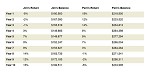
Let’s say that Don’s portfolio earns an average of 7% a year for 10 years. However, his annual returns have been very uneven; one year his return might be 11%, another year it might be down 10%. Meanwhile, Betty’s portfolio also has averaged a 7% annual return in the same time, but her returns have been more even; she hasn’t had spectacular years, but she has avoided any negative annual returns.
A health insurance Exchange is essentially a one-stop health insurance marketplace. Exchanges are not issuers of health insurance. Rather, they contract with insurance companies who then make their insurance coverage available for examination and purchase through the Exchange. In essence, Exchanges are designed to bring buyers and sellers of health insurance together, with the goal of increasing access to affordable coverage.
The Patient Protection and Affordable Care Act does not require that anyone buy coverage through an Exchange. However, beginning in 2014, each state will have one Exchange for individuals and one for small businesses (or they may combine them). States have the option of running their own state-based Exchange or partnering with the federal government to operate a federally facilitated Exchange. States not making a choice default to a federally run Exchange.